Uniswap Review: When a Swap Beats a Centralized Exchange, and When It Does Not
Uniswap charges pool fees from 0.05% to 1% on v3 and nothing for custody, but you pay network gas and carry scam-token risk. We compare it with buying on a centralized exchange.
The verdict
Uniswap is the most trusted on-chain swap venue, and for long-tail tokens that no exchange lists it is often the only option. It is not automatically cheaper: you pay a pool fee of 0.05% to 1% plus network gas, and you carry the risk of fake tokens and bad approvals. Use it for tokens you can verify, on a low-cost network, with a wallet you trust.
Best for Self-custody users swapping tokens that centralized exchanges do not list
Pros
- No account, no custody and no withdrawal step: your wallet holds the tokens
- Lists tokens that centralized exchanges never will, across many networks
- Pool fees are published: v3 tiers of 0.05%, 0.30% and 1%
- Open, audited-in-public contracts and years of live use behind them
Cons
- Network gas can wipe out the saving on small trades, especially on Ethereum mainnet
- Anyone can create a token and a pool, so scam and clone tokens are common
- Price impact and slippage grow on thin pools, and routing is not guaranteed best
- Interface fees have changed over time, so check the quote before you confirm
There is a simple test for whether Uniswap beats a centralized exchange on a given trade: add up everything you will pay on both sides, then ask whether you can verify what you are buying. Uniswap wins on the second question for obscure tokens and on custody. It wins on the first only sometimes. Here is how we run that test.
What Uniswap is, in one paragraph
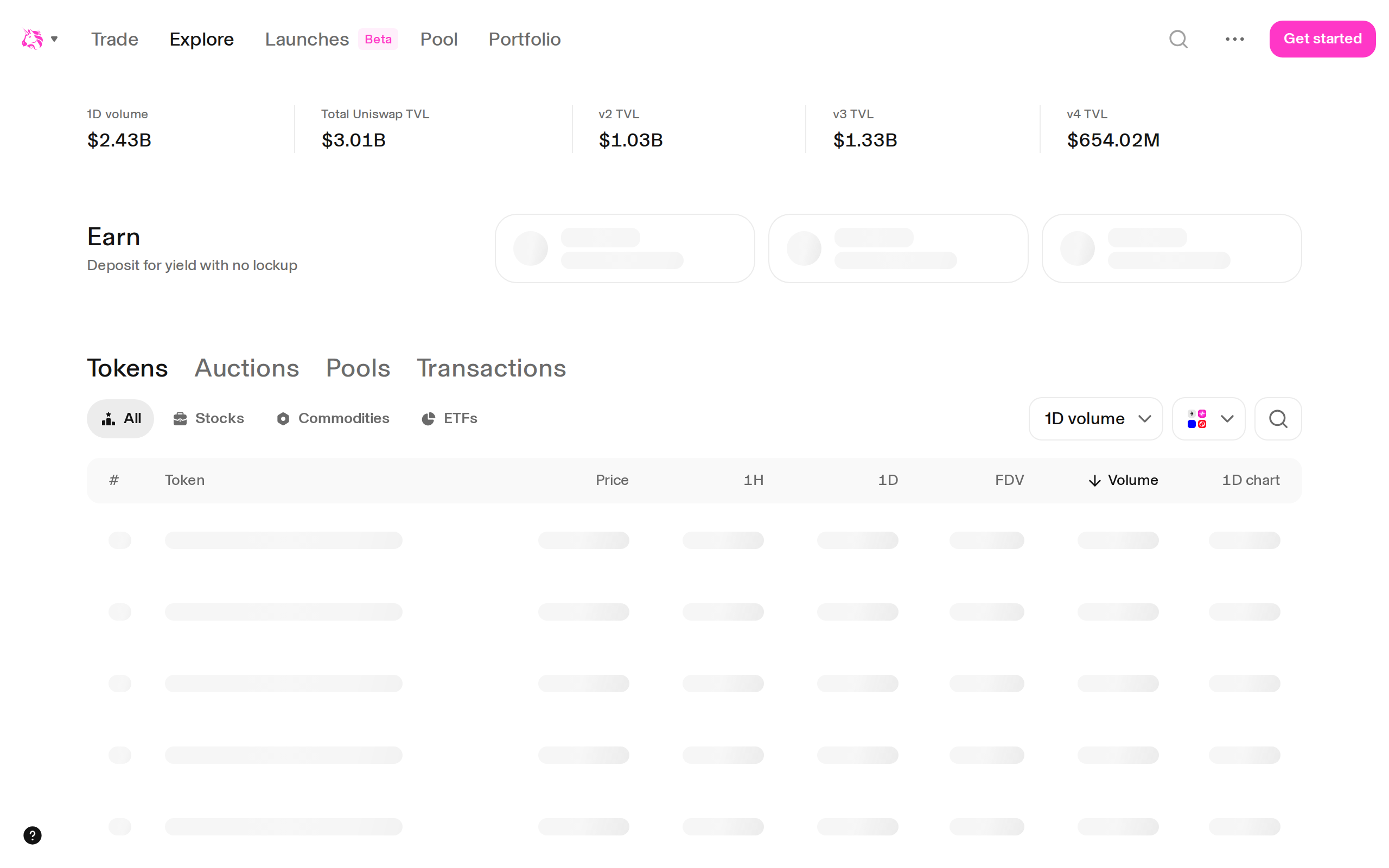
Uniswap is an automated market maker. Instead of an order book, you trade against a pool of two tokens that liquidity providers have funded. You connect a wallet, pick the tokens, and the contract settles the swap on-chain. Nobody holds your funds in between, and there is no sign-up.
What a swap actually costs
Every Uniswap swap pays a fee to the liquidity providers. The developer docs say v3 pools come in tiers of 0.05%, 0.30% and 1%, with governance able to add more. In v4, pool creators can set any fee from 0% to 100%, so you should read the number on the pool you are about to use.
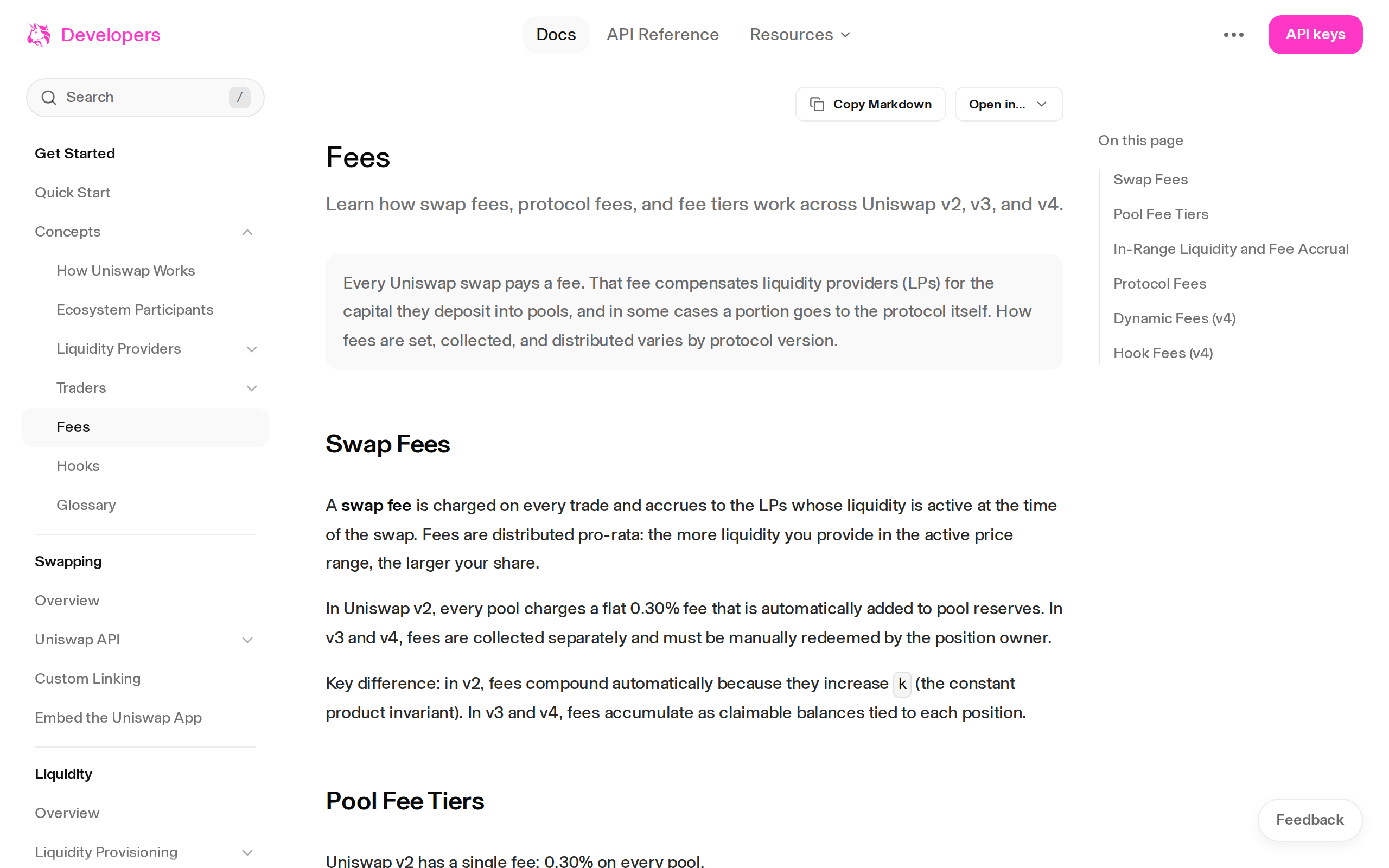
A protocol share has also been switched on. The docs say that from December 2025 protocol fees apply to all v2 pools and select v3 pools, at about one-sixth of the swap fee. That comes out of what liquidity providers earn, not out of an extra charge to you.
Then there is Uniswap Labs' interface fee. Uniswap Labs raised it to 0.25% from 0.15% in April 2024, according to The Block. Search summaries of its support page say the company stopped charging interface fees at the end of December 2025. The official page refused automated access, so we could not confirm that ourselves. Look at the fee line in the quote before you sign.
The last cost is gas. On Ethereum mainnet a swap can cost several dollars, which is brutal on a $50 trade. On cheaper networks it is cents.
The comparison that decides it
Take a $2,000 swap between two large tokens on a low-cost network, in a 0.05% pool. The pool fee is $1, and gas is small. A centralized exchange at around 0.1% charges $2, so Uniswap can be cheaper, provided the pool is deep and price impact is low.
Now take a $100 swap on mainnet in a 0.30% pool. The pool fee is $0.30, but gas may be $5 or more. The exchange wins by a wide margin.
For a token no exchange lists, there is no comparison. Uniswap is the only door, which brings us to risk.
Safer and riskier at the same time
You never hand over custody, so an exchange failure cannot take your balance. That is a real safety gain compared with a platform that can freeze or lose funds.
The risk moves elsewhere. Anyone can create a token and a pool, and scammers copy names and logos. An approval you grant to a contract can be abused later. A swap on a thin pool can get a poor price, and bots can trade around you.
Our rules, which are not personal advice: check the contract address from the project's own site, do not buy tokens that appeared in a message, set a modest slippage limit and revoke approvals you no longer need.
Who earns from the pools
Liquidity providers deserve a short note, since the fee you pay is their income. Providing liquidity is not a savings account. A provider can lose value when prices move against the pool, which the trade calls impermanent loss, and a concentrated v3 position can stop earning altogether when the price leaves its range. We treat pool deposits as a separate, higher-risk activity from swapping, and this review covers swapping only.
The swap screen
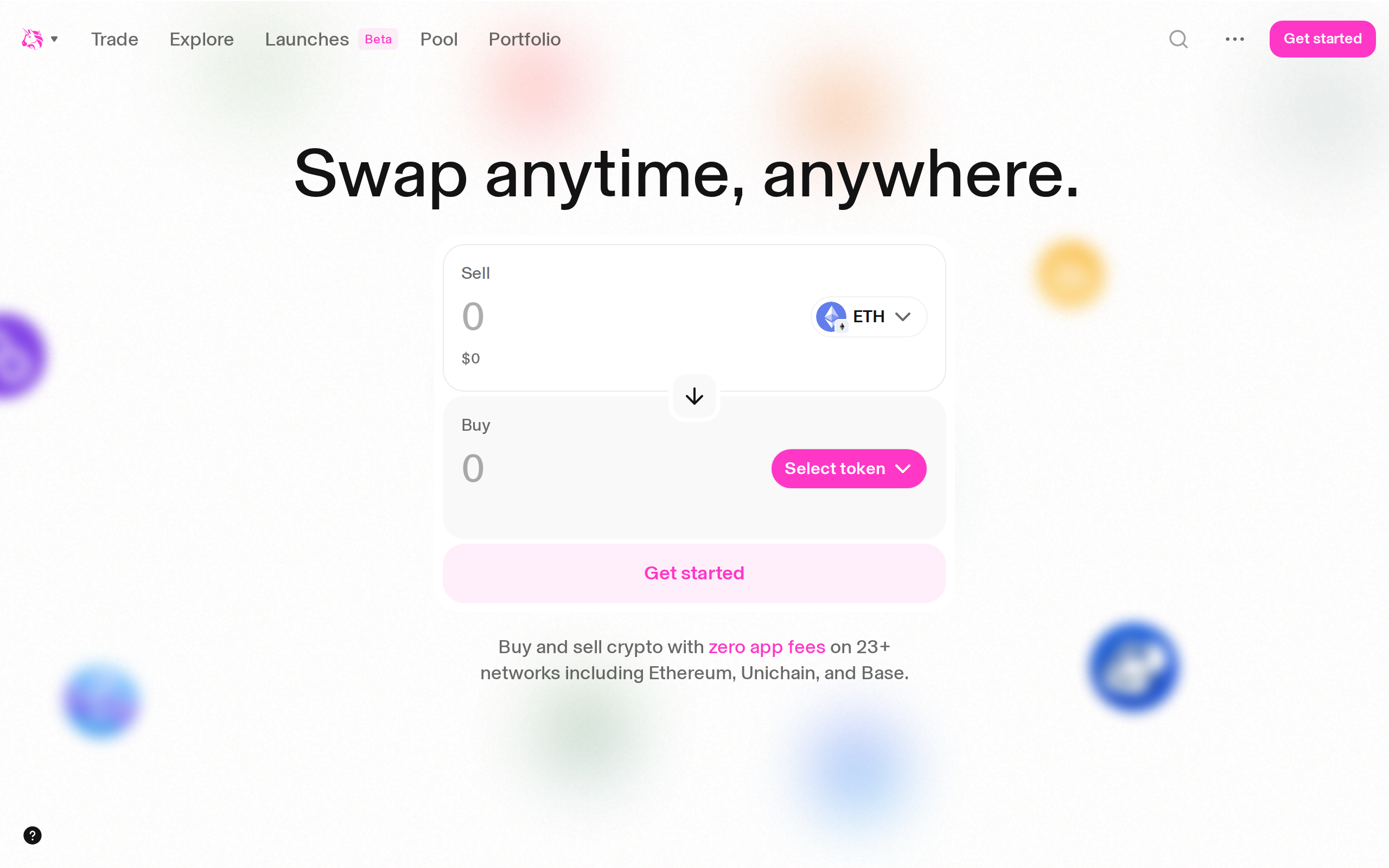
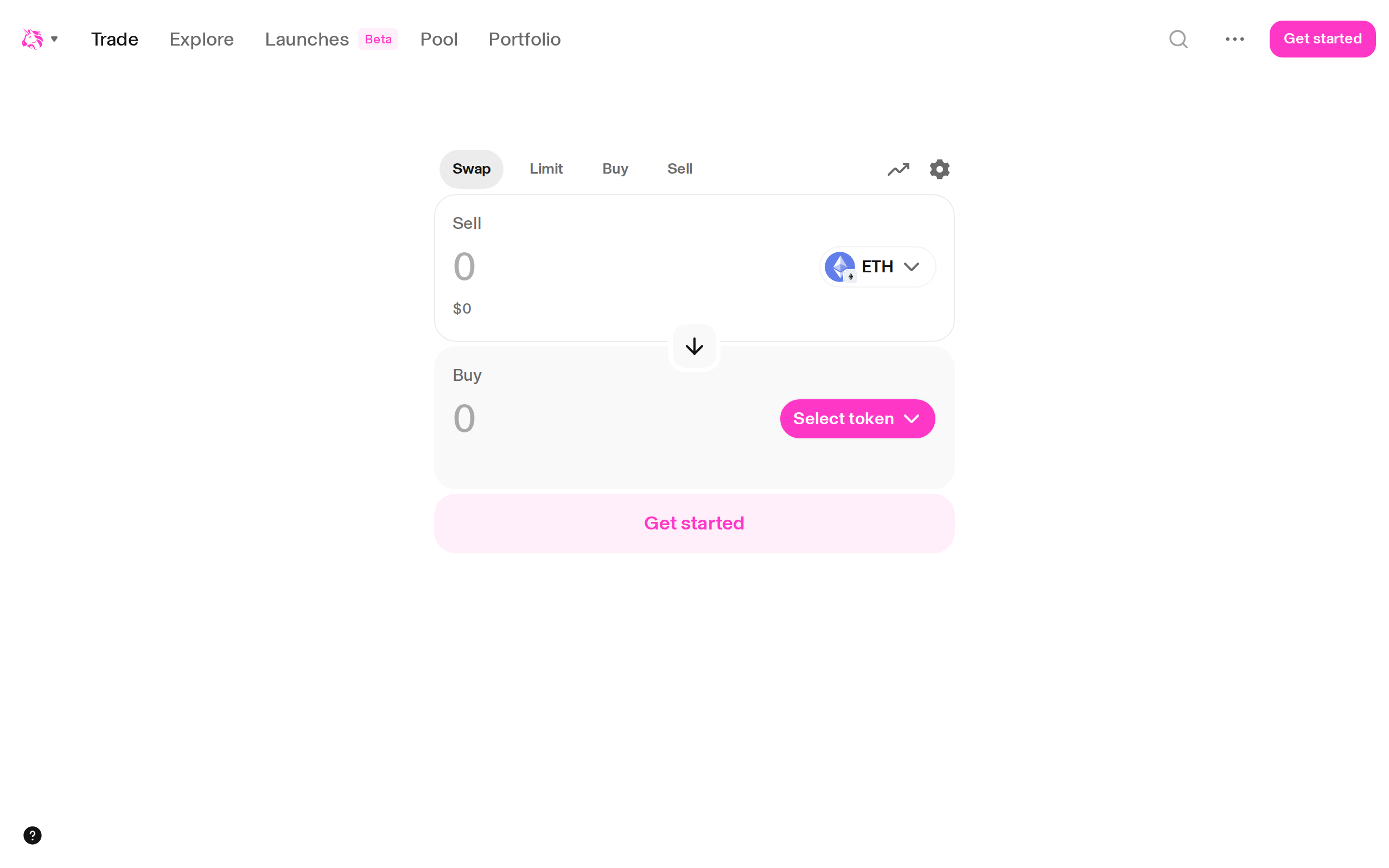
The swap box is deliberately plain: choose a pair, type an amount, review the quote, confirm in your wallet.
The wallet
Uniswap Labs also makes its own wallet, which it describes as simple, safe and secure.
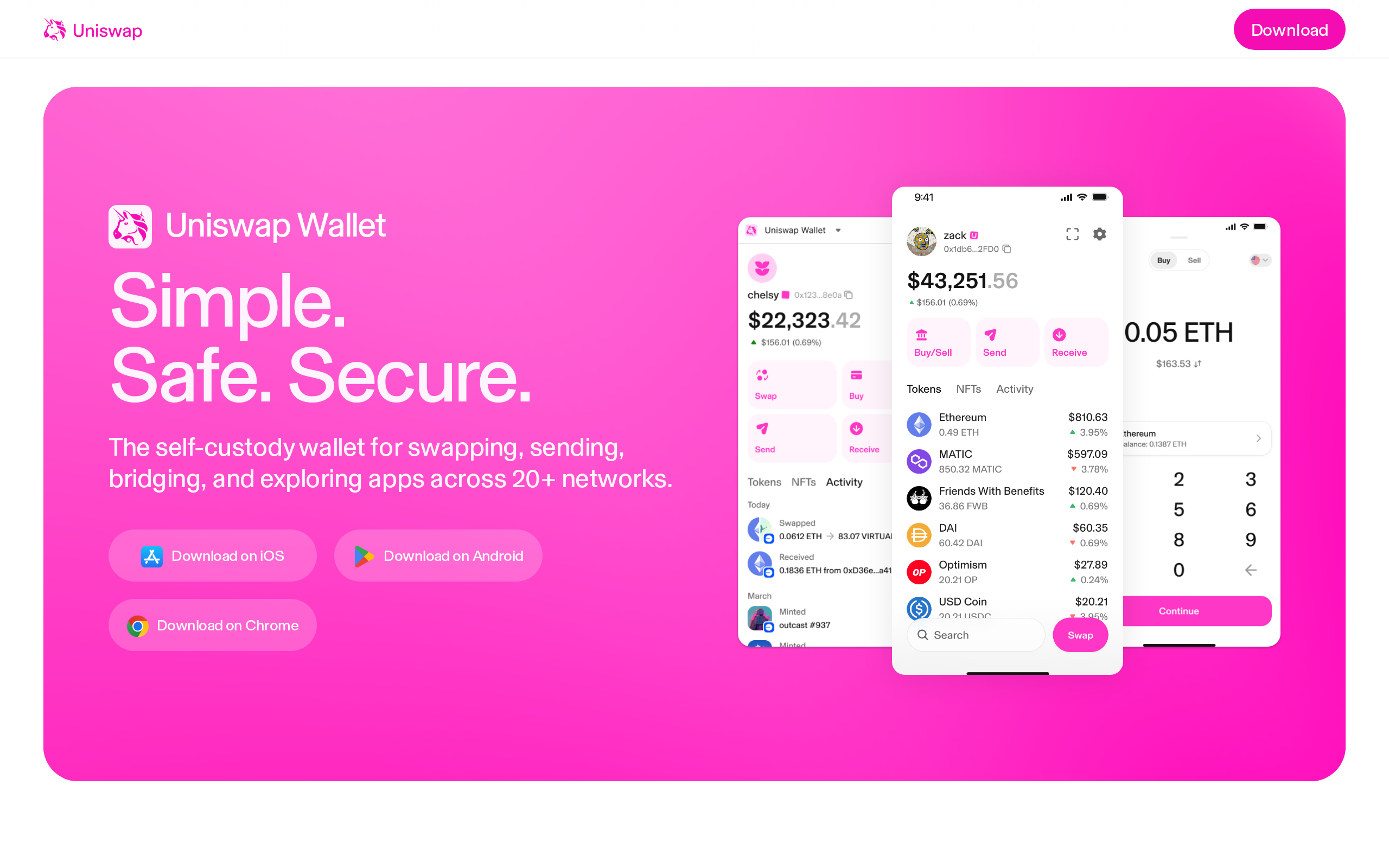
You do not need it. The protocol works with MetaMask, Phantom, Rabby and hardware wallets through a connection. We would use a hardware wallet for anything of size.
Verdict
Uniswap earns an 8.2. It is not a cheaper Coinbase. It is a different tool: non-custodial, open, and the place where new tokens trade first. Use it for tokens you have verified, on an inexpensive network, in deep pools. Stay on a centralized exchange for small trades on mainnet or when you want fiat in and out. None of this is personal financial advice.
Specifications
- Maker
- Uniswap Labs (protocol governed by UNI holders)
- Type
- Non-custodial automated market maker
- v3 pool fee tiers
- 0.05%, 0.30% and 1% per the developer docs
- v4 pool fees
- Any fee from 0% to 100% set by the pool creator
- Who earns the fee
- Liquidity providers, with a protocol share on some pools
- Protocol fee
- Active on all v2 and select v3 pools since December 2025
- Interface fee
- 0.25% from April 2024; reported removed in December 2025
- Other products
- Uniswap Wallet, pools, tokens explorer, API
As published by Uniswap Labs when we tested it.