Robinhood Crypto Review: Easy Buying and Withdrawals, With the Cost Hidden in the Spread
Robinhood Crypto charges no commission, now allows withdrawals to your own wallet and has added staking. We looked at the spread, the 1.75% instant cash-out fee, the 25% staking cut and the limits for each state.
The verdict
Robinhood is a sensible place for a US investor who already holds stocks there and wants a few coins, now that withdrawals to your own wallet and staking exist. It is not the cheapest: the default route costs a spread of roughly 0.3% to 2%, and the exchange route starts at 0.50% maker and 0.95% taker. Crypto is not FDIC or SIPC protected. Active traders and altcoin hunters will outgrow it.
Best for US investors who want a few major coins beside their stocks
Pros
- No commission on the default route, and the app is simple to use
- Crypto withdrawals and deposits have no Robinhood fee, only network fees
- Staking from $1 for ETH and SOL, plus a self-custody wallet
- Exchange routing with maker and taker fees cuts costs for larger traders
Cons
- The spread is the hidden cost, and it varies by coin and market conditions
- Staking keeps about 25% of rewards as commission
- Crypto is not covered by FDIC or SIPC protection
- State rules limit staking, exchange routing and some tokens in several places
The old complaint about Robinhood Crypto was that you could buy coins but never take them home. That is no longer true, and it changes the question. Robinhood now lets you withdraw to your own address, stake and use a self-custody wallet, so the issue is price. "Commission-free" does not mean free, and we spent most of our time on where the money goes.
Zero commission, one spread
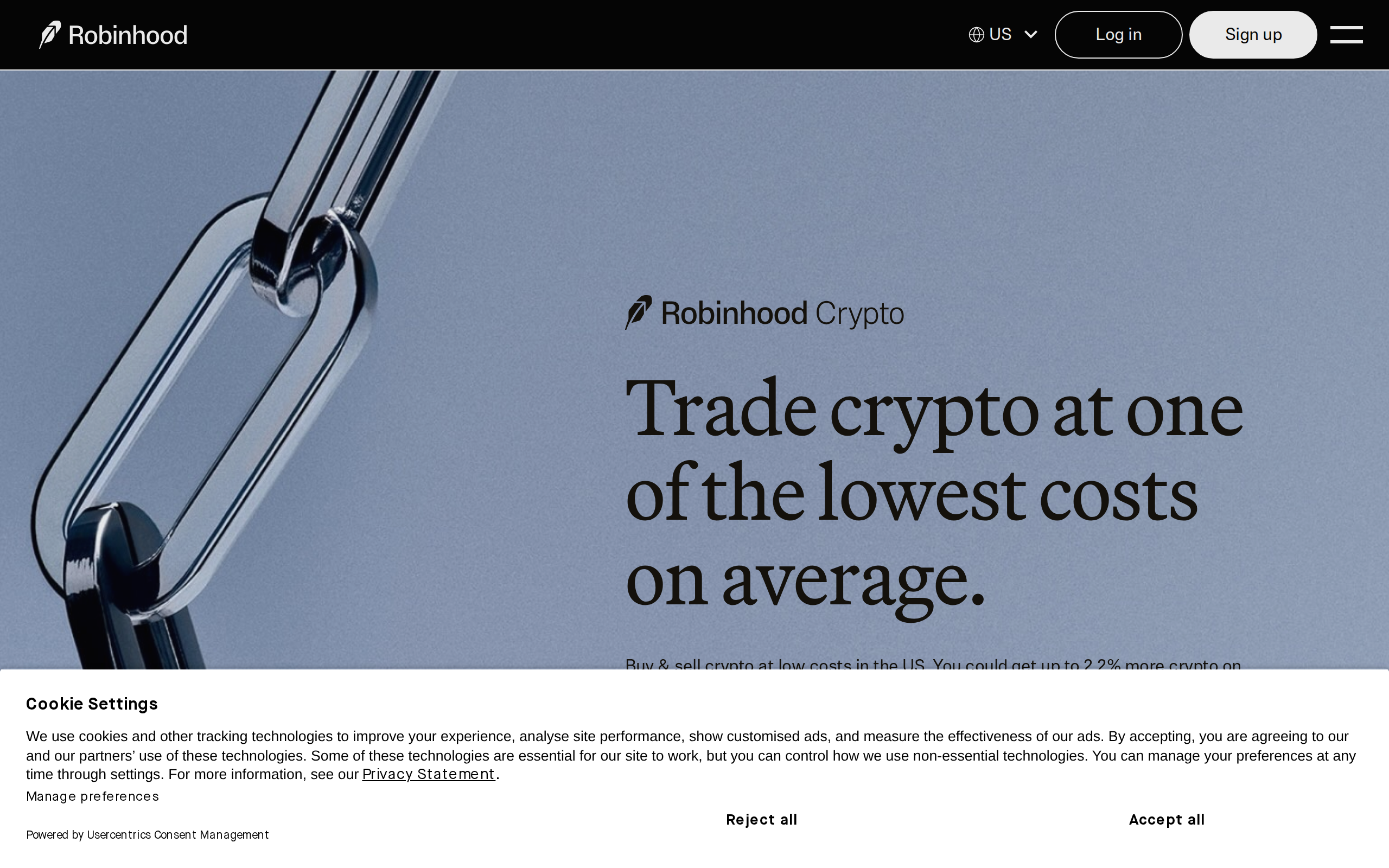
The default route charges no commission. Robinhood is paid in the gap between the price it quotes and the market price. Reviewers put that spread at about 0.3% to 0.8% on simple buys and up to 2% when markets are choppy or the coin is thin, according to Bitget Academy's fee guide. The company's page claims "one of the lowest costs on average," and that is a claim about averages, not about every trade.
There is a cheaper route for larger orders. Exchange routing charges explicit maker and taker fees, starting at 0.50% maker and 0.95% taker under $10,000 of 30-day volume and falling to 0.00% maker at $25 million, per CryptoSlate's review. At the entry tier that is not cheap, so the route pays off only with volume.
Funding is where a small surprise lives. Standard ACH withdrawals cost nothing, but an instant cash-out to a card or bank carries 1.75% (minimum $1, maximum $150). Use the slow option unless you are in a hurry.
Withdrawals changed the product
Taking coins to a wallet you control is the feature that matters most. Robinhood charges no platform fee on crypto withdrawals or deposits, so you pay only network fees. New addresses sit in an allowlist with a 48-hour wait, which is slow but a sensible defence against a drained account.
Robinhood also offers its own self-custody wallet.
Treat that as a convenience. If you hold meaningful sums, a hardware wallet such as the Ledger Nano Gen5 is still the safer home, and withdrawing there is now possible.
Staking, and the 25% bite
Staking for ETH and SOL arrived for US customers with a $1 minimum, and ADA has been added, per CryptoSlate. Convenience is the draw. The price is that Robinhood keeps roughly 25% of the rewards, a figure that includes partner and platform fees.
Giving up a quarter of what the network pays is a real cost. Staking is also unavailable in California, Maryland, New Jersey and Wisconsin. Compare the rate you would receive after commission with what Kraken or a direct wallet would pay.
Coins, states and protection
Coverage is moderate. CryptoSlate counts 90 tradable assets on the market maker route, 66 on exchange routing and 45 view-only assets. Dedicated trading venues list far more, and Robinhood is not the place to chase new tokens.
State rules matter more than most readers expect. New York and Texas restrict some stablecoins, North Carolina has no exchange routing, and the staking exclusions above apply.
Crypto at Robinhood is not FDIC insured or SIPC protected. The company says most coins are held offline and that crime insurance covers part of the assets, which is not the same as deposit insurance. Its record includes a $30 million New York penalty in 2022 for compliance and cybersecurity failings, and a 2021 social-engineering incident that exposed customer data without reported financial loss.
What we would check before funding it
Three habits keep the cost down. First, read the quote screen and compare the price shown with a second source for the same coin and minute. Second, send ACH, not instant transfers, whenever time allows. Third, move long-term holdings off the platform, since the withdrawal route now exists and the protection gap is real.
A fourth is to keep records. Robinhood is a US broker, so crypto sales are reportable, and the tax software you already use, such as Koinly, can import the history.
Robinhood Chain, briefly
Robinhood also links to its own chain, which it describes as finance onchain. We did not need it to judge the trading product, and nothing about it changes the fee picture above.
Who should use it
Use Robinhood Crypto if you are in the US, already keep stocks there, want Bitcoin, Ether or a few large coins, and value one app above the last half percent. Withdrawals now make it a reasonable on-ramp.
Look elsewhere if you trade often, hold small altcoins, or want the lowest all-in cost. Coinbase is the comparison most readers make, and it charges for the same comfort. CryptoSlate scores Robinhood 7.6 out of 10 and we land a little lower because of the spread and the staking cut.
This is a review, not advice for your own circumstances. Check the quote screen for the spread before you confirm a buy.
Specifications
- Trading cost
- No commission; spread typically 0.3% to 2%
- Exchange route
- 0.50% maker, 0.95% taker under $10,000 of 30-day volume
- Coins
- About 90 tradable on the market maker route, 66 on exchange routing
- Withdrawals
- No Robinhood fee; 48-hour wait on new allowlist addresses
- Instant cash-out
- 1.75%, minimum $1, maximum $150; ACH is free
- Staking
- From $1, about 25% commission on rewards
- Protection
- Not FDIC or SIPC insured; crime insurance on part of assets
- Regulatory record
- $30 million New York penalty in 2022
- Availability
- All 50 states, with product limits in NY, TX, NC, CA, MD, NJ, WI
As published by Robinhood when we tested it.