Exodus Review: A Beautiful Free Wallet Whose Swap Spread Is the Real Price
Exodus is the best-looking free multi-chain wallet, and it needs no ID to open. We weighed its 0.5% headline swap fee against the 2% to 5% independent reviewers measure, and its closed code against Trezor pairing.
The verdict
Exodus is the friendliest self-custody wallet for a first-time holder, and installing it costs nothing. The bill arrives inside swaps, where a 0.5% headline fee turns into roughly 2.2% on mid-size trades and about 5% on tiny ones, per independent figures. The core app is closed source and there is no 2FA. Use it for holding and occasional swaps, pair it with a Trezor, and do large trades elsewhere.
Best for Beginners who want a polished, no-ID multi-chain wallet
Pros
- Free desktop and mobile apps with a clean design that beginners can navigate alone
- Core wallet needs no identity check to create or use
- Pairs with Trezor on desktop, keeping keys on a separate device
- Built-in staking for chains such as Solana, Cardano and Cosmos
Cons
- Swap spreads push real costs to about 2.2% mid-size and near 5% small
- Most of the wallet code is proprietary, so outsiders cannot audit it fully
- No two-factor option: a device password and biometrics are the only gate
- Hardware support is narrower than the headline suggests, mainly major coins
Exodus is the wallet people recommend to a relative who has never held crypto, and the recommendation is fair. It looks good, asks for nothing up front and does not scare you with jargon. The catch is that "free" describes the download, not the swaps, and a wallet that earns its keep from spreads has a reason to make swapping the easiest thing on screen.
Where the money goes when the app is free
Exodus charges no fee to install or hold. Revenue comes from the exchange built into the app and from fiat partners. Its own marketing quotes swap fees from 0.5%, then adds a variable spread that moves with liquidity.
The gap between that headline and your actual cost is the whole story. Independent figures compiled by Spoted Crypto put the all-in cost near 5% on swaps of $25 to $100, about 2.2% on $500 to $1,000, and 0.5% to 1% only on trades around $5,000. A $100 swap that costs $5 is a bad deal when a decentralized exchange or a centralized venue would charge a fraction of that.
Our rule of thumb: swap in Exodus when convenience is worth a couple of percent, and move size elsewhere. If you only buy and hold, you will rarely feel the problem.
The desktop app is the draw
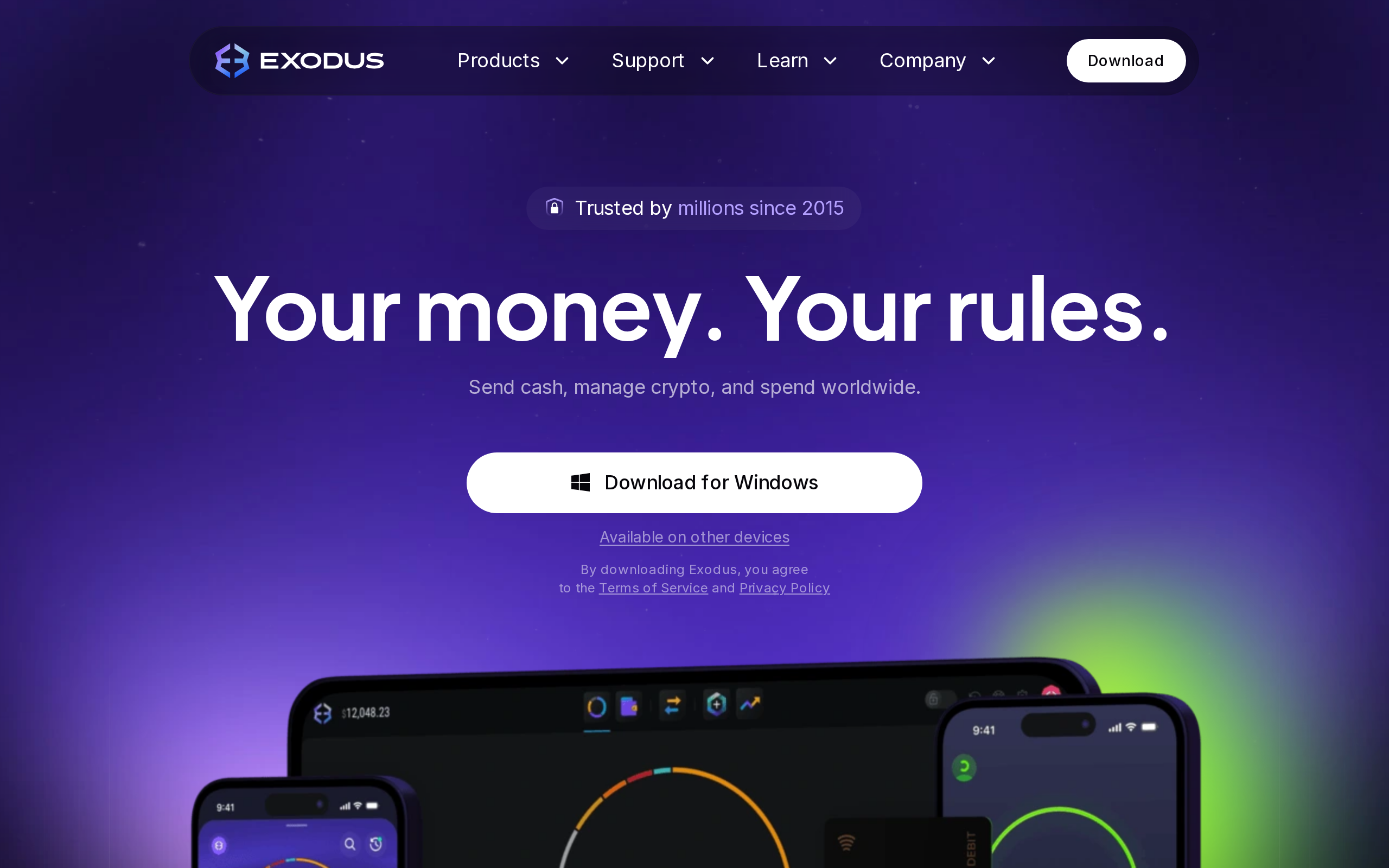
Exodus runs on Windows, macOS and Linux, and on iOS and Android, with a browser extension for Web3 sites. The download page shows the desktop and mobile versions side by side, and the layout is the same on both, which helps if you switch between phone and laptop.
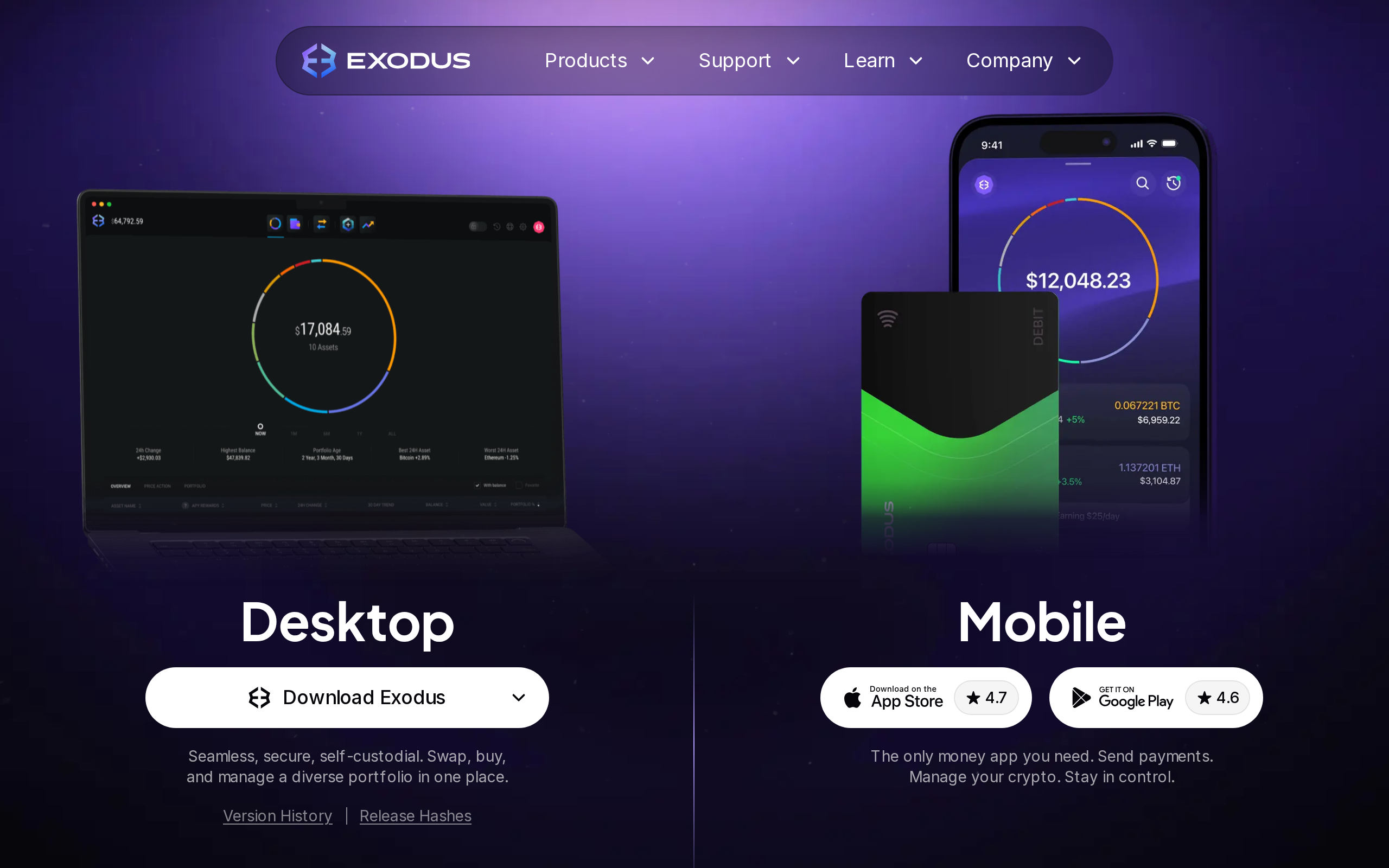
Coverage is wider than most free wallets offer for a first install. Reviewers count roughly 269 native assets shown in the interface across more than ten chains, including Bitcoin, Ethereum, Solana, BNB Chain, Base and Arbitrum. The marketed total of over a million tokens counts everything reachable through swaps, not what is curated in the list. Gaps exist: Monero support ended, and Bitcoin Ordinals cannot be managed inside the wallet.
Staking is built in and tidy. The staking page promises rewards without leaving the app, and third-party rates we saw were around 5.8% for SOL and 5% for ADA, though they float with the network.
Security: good enough for small balances, with caveats
Keys are generated on your device and protected by a 12-word recovery phrase, encrypted locally with AES-256. Exodus does not hold them. That is real self-custody.
What it lacks matters to some readers. The wallet interface and the glue code that joins its chains together stay proprietary, so you cannot read what you run. State of Surveillance also notes there is no traditional 2FA, which is by design since there is no central account, and that buying inside the app triggers identity checks through partners such as MoonPay and Ramp. The core wallet itself needs no ID, but Exodus Pay and the card do.
The practical answer to closed code is a hardware wallet. Exodus supports Trezor on desktop and, per the same source, the Trezor Safe 7 on mobile over Bluetooth. Ledger pairing also exists.
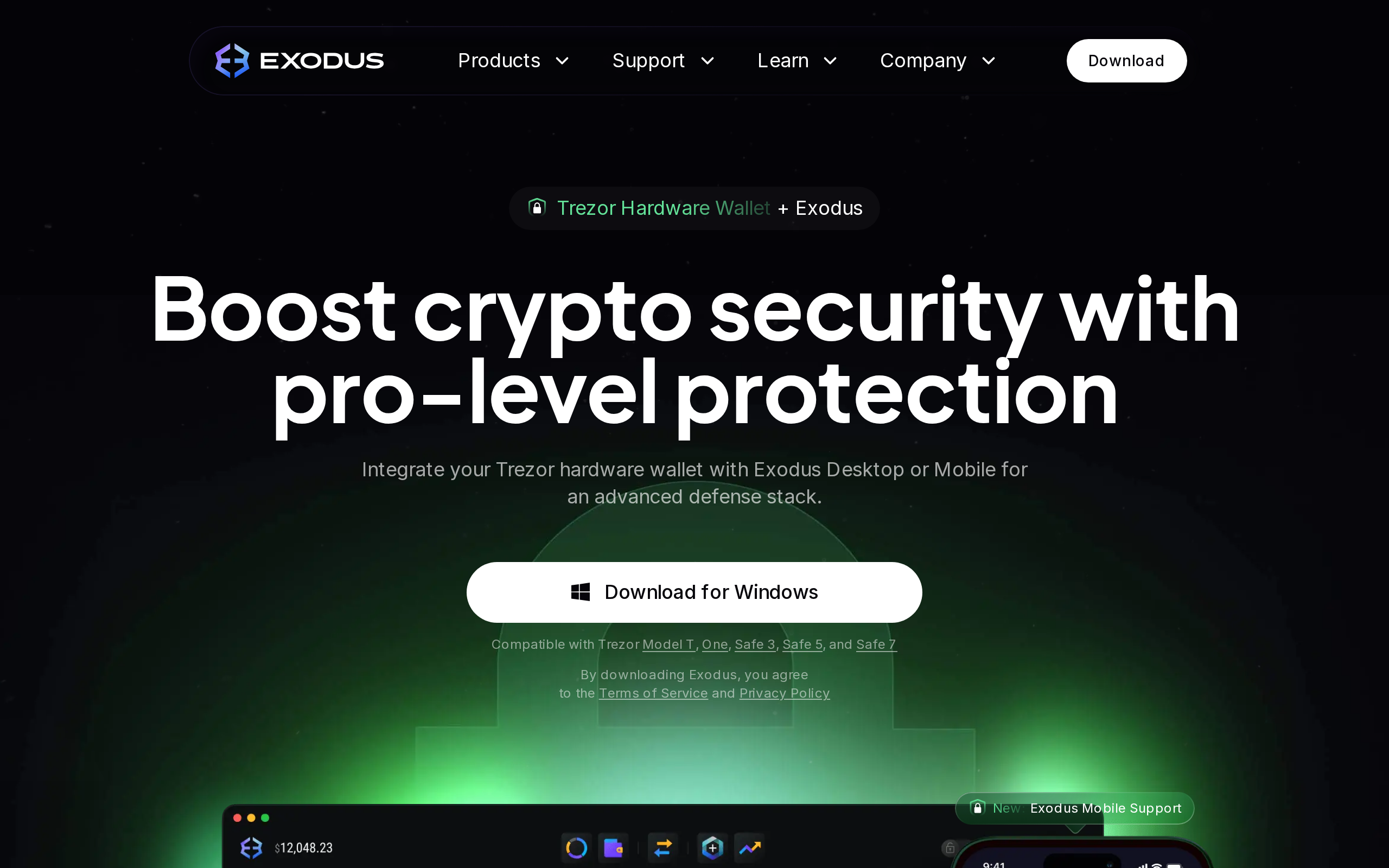
Hardware support is narrower than the pitch suggests. The same source lists Bitcoin, Ethereum, ERC-20 tokens, Litecoin, Dash, XRP and Stellar, so a Solana or Cardano holder cannot sign everything from the device.
The newer pieces: Exodus Pay and tokenized stocks
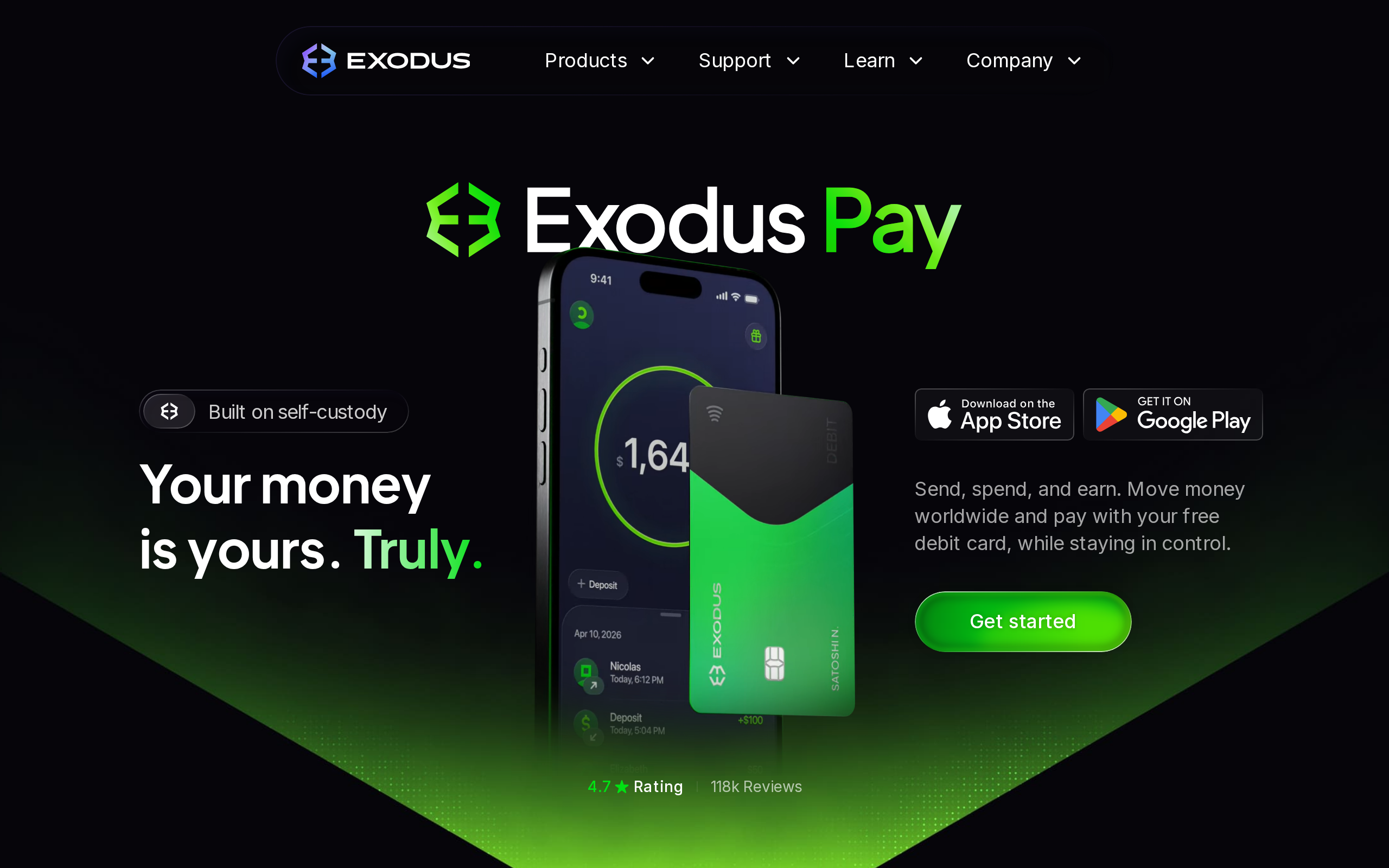
Exodus is stretching beyond a wallet. The Pay page pitches sending payments, spending and earning rewards, and the company launched a markets product with Ondo Finance in June 2026 offering tokenized stocks and ETFs on Solana. These need full identity verification, unlike the wallet. We treated them as extras, not as reasons to choose the app.
The company itself is a listed business, Exodus Movement on NYSE American, which means audited accounts and public filings. Independent reporting put Q1 2026 revenue at $22.7 million, down 37% from a year earlier. A fall like that is a reason to expect more product pushes in the app, not a solvency alarm for a wallet that never holds your coins.
Who should use it
Use Exodus if you are new, hold modest amounts, value a design that does not intimidate, and will swap rarely. Add a Trezor if the balance grows.
Skip it if you swap often, if open-source code is a hard requirement, or if you want the deepest DeFi tooling. MetaMask is fully inspectable on EVM chains, and Phantom is stronger for Solana. For a long-term store of value, a dedicated hardware wallet beats any hot wallet.
Nothing here is personal financial advice. Check the fee shown in the quote before you confirm any swap, and compare it with a second venue.
Specifications
- Type
- Self-custody software wallet (desktop, mobile, browser extension)
- Price
- Free; revenue comes from swap spreads and on-ramp partners
- Headline swap fee
- From 0.5% plus a variable spread
- Measured swap cost
- About 5% under $100, about 2.2% at $500 to $1,000 (third-party figures)
- Recovery
- 12-word phrase, encrypted locally with AES-256
- Hardware support
- Trezor (desktop and mobile on Safe 7), Ledger
- Networks
- Bitcoin, Ethereum, Solana, BNB Chain, Base, Arbitrum and more
- Source code
- Partly open, wallet interface proprietary
- Company
- Exodus Movement, listed on NYSE American (EXOD)
As published by Exodus when we tested it.